" height="19.64919127351955px" id="feLJnUdWF" transform="translate(13.072 0.171)" width="98.40907551280239px"/><path d="M 58.91 0.341 C 60.034 0.771 60.961 1.571 61.457 2.685 C 62.022 3.955 61.939 5.671 61.447 6.953 C 61.117 7.813 60.351 9.09 59.481 9.48 C 59.904 9.615 61.011 10.58 61.237 10.961 C 61.507 10.792 61.65 10.319 61.882 10.083 C 61.993 9.971 62.156 9.864 62.317 9.864 C 62.852 9.867 64.601 10.887 64.981 11.282 C 65.106 11.413 65.135 11.562 65.128 11.738 C 65.106 12.346 64.203 14.024 63.776 14.422 C 64.138 14.708 64.377 15.424 64.548 15.852 C 64.78 16.431 64.974 17.02 65.09 17.634 C 65.24 18.419 65.371 20.724 65.05 21.466 C 64.968 21.656 64.81 21.804 64.615 21.874 C 64.077 22.082 61.948 22.019 61.415 21.782 C 60.605 20.715 61.571 18.997 60.829 17.868 C 60.806 17.963 60.687 18.071 60.619 18.138 C 59.498 19.253 58.111 19.688 56.554 19.678 C 54.746 19.665 52.878 19.066 51.588 17.748 C 50.484 16.618 49.921 15.054 49.94 13.482 C 49.957 12.026 50.63 10.678 51.683 9.695 C 52.046 9.355 52.467 9.072 52.818 8.725 C 52.825 8.648 52.125 7.445 52.038 7.259 C 51.925 7 51.837 6.73 51.777 6.454 C 51.441 5.067 51.43 3.45 52.193 2.197 C 52.912 1.017 54.051 0.401 55.355 0.084 C 56.405 -0.064 57.923 -0.038 58.91 0.341 Z M 55.546 11.624 L 55.539 11.631 C 54.879 12.378 53.889 12.512 53.96 13.777 C 53.964 13.843 53.972 13.909 53.983 13.975 C 54.003 14.107 54.037 14.237 54.083 14.362 C 54.129 14.487 54.187 14.608 54.256 14.722 C 54.291 14.779 54.329 14.834 54.37 14.887 C 54.41 14.94 54.453 14.992 54.498 15.041 C 54.542 15.09 54.589 15.136 54.639 15.181 C 55.21 15.689 56.025 15.849 56.767 15.803 C 56.906 15.793 57.097 15.791 57.222 15.733 C 57.843 15.6 58.589 15.025 58.914 14.476 C 58.932 14.446 58.941 14.412 58.942 14.378 C 58.745 13.764 56.454 11.947 55.865 11.646 C 55.741 11.583 55.677 11.606 55.546 11.623 Z M 56.271 3.782 C 56.054 3.825 55.887 3.869 55.756 4.062 C 55.517 4.417 55.602 4.926 55.682 5.322 C 55.807 5.932 56.122 6.401 56.417 6.932 C 56.529 6.867 56.742 6.759 56.787 6.627 C 57.242 6.388 57.547 5.941 57.696 5.457 C 57.804 5.109 57.85 4.628 57.745 4.278 C 57.704 4.122 57.602 3.989 57.461 3.909 C 57.137 3.726 56.633 3.742 56.271 3.782 Z M 4.109 0.42 C 6.557 0.42 8.439 0.446 10.32 2.296 C 10.468 2.441 10.61 2.592 10.744 2.75 C 10.944 2.989 11.128 3.241 11.294 3.505 C 11.457 3.77 11.601 4.047 11.724 4.333 C 11.848 4.619 11.95 4.913 12.028 5.215 C 12.079 5.416 12.123 5.619 12.158 5.824 C 12.174 5.927 12.188 6.03 12.2 6.133 C 12.224 6.339 12.238 6.547 12.24 6.755 C 12.239 7.382 12.147 8.005 11.967 8.606 C 11.936 8.706 11.903 8.805 11.868 8.903 C 11.732 9.298 11.555 9.677 11.34 10.035 C 11.18 10.303 11.001 10.56 10.806 10.805 C 10.674 10.966 10.536 11.121 10.39 11.27 C 9.117 12.564 7.55 13.196 5.75 13.206 C 5.353 13.202 4.824 13.143 4.468 13.33 C 3.984 13.795 4.362 17.804 4.232 18.749 C 4.201 18.969 4.146 19.188 3.962 19.329 C 3.453 19.507 1 19.517 0.449 19.405 C 0.329 19.385 0.223 19.316 0.155 19.215 C 0.04 19.037 0.035 18.707 0.028 18.498 C -0.019 17.045 0.025 15.578 0.028 14.124 L 0.03 2.386 C 0.03 1.933 -0.048 1.342 0.047 0.908 C 0.097 0.674 0.201 0.576 0.397 0.451 C 0.549 0.439 0.701 0.43 0.853 0.427 C 1.938 0.412 3.024 0.421 4.109 0.421 Z M 4.716 3.703 L 4.633 3.706 C 4.457 3.82 4.326 3.901 4.279 4.116 C 4.167 4.631 4.208 9.261 4.354 9.716 C 4.566 9.935 4.818 9.956 5.109 9.96 C 5.939 9.969 6.594 9.903 7.249 9.347 C 7.954 8.601 8.241 7.592 8.216 6.573 C 8.196 5.762 7.93 4.908 7.332 4.338 C 6.599 3.638 5.659 3.676 4.716 3.703 Z M 31.87 0.536 C 32.26 0.611 32.642 0.724 33.01 0.871 C 33.38 1.017 33.735 1.197 34.072 1.409 C 35.482 2.296 36.583 3.776 36.957 5.412 C 36.98 5.517 37.002 5.622 37.022 5.727 C 37.058 5.939 37.083 6.152 37.099 6.367 C 37.115 6.581 37.119 6.796 37.111 7.011 C 37.103 7.226 37.084 7.44 37.056 7.653 C 37.013 7.972 36.944 8.288 36.85 8.596 C 36.787 8.801 36.715 9.004 36.633 9.203 C 36.592 9.302 36.548 9.4 36.501 9.496 C 36.363 9.787 36.201 10.066 36.017 10.331 C 35.715 10.774 35.307 11.149 35.025 11.604 C 34.945 11.733 34.843 11.923 34.841 12.078 C 34.833 12.544 37.281 17.761 37.537 18.892 C 37.573 19.049 37.594 19.158 37.509 19.295 C 36.938 19.516 33.899 19.538 33.303 19.298 C 32.732 18.573 31.767 15.836 31.358 14.794 C 31.195 14.38 31.042 13.801 30.741 13.47 C 30.535 13.244 30.258 13.188 29.962 13.177 C 29.735 13.169 29.504 13.216 29.335 13.377 C 29.188 13.518 29.118 13.729 29.089 13.927 C 29.023 14.374 29.077 14.874 29.085 15.327 C 29.101 16.404 29.149 17.502 29.115 18.577 C 29.107 18.816 29.056 19.117 28.872 19.287 C 28.759 19.39 28.605 19.418 28.458 19.435 C 28.078 19.479 27.679 19.425 27.295 19.425 C 26.76 19.427 26.212 19.475 25.677 19.445 C 25.45 19.433 25.185 19.415 25.025 19.231 C 24.887 19.071 24.881 18.878 24.871 18.674 C 24.812 17.565 24.858 16.431 24.857 15.318 L 24.855 3.718 C 24.857 2.831 24.805 1.906 24.867 1.025 C 24.888 0.745 25.026 0.644 25.225 0.47 C 25.957 0.325 31.135 0.396 31.87 0.536 Z M 29.443 3.729 C 29.256 3.875 29.153 3.953 29.123 4.197 C 29.054 4.74 29.007 9.446 29.213 9.705 C 29.366 9.895 29.633 9.941 29.863 9.961 C 30.533 10.019 31.423 9.93 31.954 9.476 C 31.992 9.448 32.019 9.407 32.03 9.361 C 32.514 9.084 32.774 8.441 32.914 7.924 C 33.184 6.936 33.164 5.841 32.65 4.934 C 32.342 4.371 31.819 3.958 31.2 3.79 C 30.672 3.646 29.983 3.645 29.443 3.729 Z" fill="rgb(255, 255, 255)" height="21.99971225177602px" id="s1sH_kHtF" transform="translate(0 0)" width="65.24835580015105px"/></svg>)
" height="46.127407407407425px" id="vkgKXHUm2" transform="translate(-0.32 0.136)" width="88.49014225370425px"/></svg>)
" height="30px" id="qG2kMAqIX" transform="translate(0 0.5)" width="77px"/></svg>)
" height="17px" id="BuW2Hqebl" transform="translate(0 0.5)" width="187.00000261145067px"/><path d="M 15.816 0.011 C 15.747 -0.016 15.668 0.007 15.625 0.067 C 15.169 0.531 12.19 3.48 7.933 3.48 L 3.389 3.48 C 2.338 3.528 1.373 4.075 0.791 4.951 C 0.508 5.323 0.257 5.714 0.036 6.124 C 0.005 6.186 -0.026 6.284 0.036 6.322 C 0.103 6.348 0.179 6.327 0.223 6.27 C 1.055 5.426 2.19 4.95 3.375 4.951 L 7.919 4.951 C 10.728 4.953 13.373 3.632 15.058 1.386 C 15.345 1.017 15.596 0.626 15.812 0.213 C 15.847 0.15 15.879 0.054 15.812 0.016" fill="rgb(255, 255, 255)" height="6.332756152064521px" id="nFYWliydZ" transform="translate(98.706 7.284)" width="15.851227719960661px"/></svg>)
" height="27.00000030112627px" id="bHk9kEaSm" transform="translate(0.242 0)" width="144.00000917507458px"/></svg>)
" height="19px" id="xdA3hsYqp" transform="translate(0 0)" width="110.99999506380652px"/></svg>)
" height="27.32563222821594px" id="T4nuhHCmY" transform="translate(0.004 6.473)" width="56.21676401301407px"/><path d="M 50.3 17.082 C 50.3 17.082 49.558 15.849 49.844 15.399 C 49.956 15.218 50.153 15.108 50.365 15.108 C 50.578 15.108 50.775 15.218 50.886 15.399 C 51.083 15.734 51.113 16.166 50.3 17.096 M 22.538 18.586 C 23.012 17.813 23.497 17.047 23.993 16.289 C 24.253 16.302 24.513 16.275 24.764 16.207 C 25.024 16.102 25.484 15.834 25.454 16.099 C 25.424 16.363 23.97 18.809 23.377 19.561 C 22.922 20.097 22.417 20.588 21.87 21.028 C 21.9 20.173 22.129 19.337 22.538 18.586 M 4.53 15.339 C 4.154 16.311 3.655 17.23 3.046 18.076 C 2.011 19.516 0.946 20.332 0.906 19.297 C 0.866 18.262 1.618 16.717 2.018 16.217 C 2.419 15.719 3.948 13.612 4.986 13.5 C 4.804 14.106 4.652 14.72 4.53 15.34 M 43.14 18.11 C 43.214 17.656 43.273 17.317 43.578 17.392 C 43.882 17.466 43.852 18.11 43.685 18.557 C 43.435 19.1 43.105 19.602 42.705 20.047 C 42.705 20.047 43.077 18.557 43.14 18.11 M 55.813 24.812 C 55.669 23.379 54.136 21.554 52.79 20.486 C 51.84 19.692 51.08 18.696 50.564 17.57 C 50.79 17.32 51.925 16.081 52.081 15.336 C 52.237 14.591 51.755 14.473 51.309 14.35 C 50.864 14.227 50.296 14.204 50.074 14.134 C 49.852 14.064 49.855 14.257 49.362 14.633 C 48.868 15.009 48.723 14.871 48.62 15.988 C 48.516 17.105 49.25 18.427 49.25 18.427 C 48.194 19.761 47.07 21.041 45.885 22.262 C 45.077 23.134 44.198 23.936 43.255 24.66 L 43.207 24.682 C 42.687 25.017 42.687 24.511 42.635 24.094 C 42.619 23.653 42.575 23.213 42.505 22.776 C 42.461 22.202 42.482 21.625 42.569 21.056 C 42.649 20.964 42.723 20.867 42.791 20.766 C 42.865 20.638 43.084 20.441 43.162 20.352 C 43.24 20.262 43.225 20.274 43.188 20.352 C 43.158 20.417 43.121 20.478 43.077 20.534 C 43.009 20.637 42.949 20.744 42.895 20.854 C 42.895 20.854 42.995 20.769 43.121 20.634 C 43.248 20.501 43.288 20.415 43.359 20.329 C 43.43 20.243 43.419 20.274 43.399 20.356 C 43.345 20.464 43.277 20.563 43.196 20.653 C 43.116 20.758 43.026 20.855 42.928 20.943 C 43.039 20.897 43.139 20.833 43.228 20.753 C 43.273 20.698 44.553 19.283 44.968 17.775 C 45.383 16.267 44.39 16.145 44.119 16.118 C 43.778 16.05 43.428 16.036 43.081 16.074 C 42.339 16.129 41.949 17.22 41.17 19.086 C 40.697 20.185 40.445 21.367 40.428 22.563 L 40.231 22.809 L 40.272 22.791 L 40.254 22.817 L 40.28 22.817 C 40.357 22.727 40.435 22.645 40.435 22.645 C 40.426 22.727 40.389 22.803 40.331 22.861 C 40.285 22.93 40.234 22.996 40.179 23.059 L 40.005 23.259 L 40.005 23.208 C 40.005 23.108 40.027 23.129 40.101 23.04 C 40.108 23.022 40.116 23.004 40.127 22.988 L 40.09 23.014 C 38.128 25.374 36.707 25.993 36.47 26.056 C 36.233 26.119 36.262 25.62 36.262 25.375 C 36.262 25.13 36.488 24.525 36.54 24.209 C 36.61 23.588 36.783 22.983 37.052 22.419 C 37.363 21.88 37.612 21.308 37.794 20.713 C 38.102 19.875 39.204 15.895 39.23 15.693 C 39.245 15.434 39.184 15.175 39.055 14.949 C 38.954 14.754 38.817 14.578 38.651 14.432 C 38.373 14.276 38.058 14.195 37.738 14.197 C 37.441 14.147 37.138 14.147 36.84 14.197 C 36.622 14.223 36.461 14.413 36.47 14.633 C 36.288 14.819 36.228 14.782 36.317 15.783 C 36.407 16.785 36.032 18.017 34.747 20.575 C 34.029 22.028 33.159 23.401 32.151 24.671 C 32.071 23.905 32.03 23.136 32.028 22.366 C 32.069 21.741 32.351 20.62 32.169 19.436 C 31.988 18.252 30.804 17.693 29.921 17.112 C 29.038 16.531 29.691 15.623 29.806 15.217 C 29.921 14.811 29.572 14.804 29.198 14.845 C 28.823 14.885 28.853 14.875 28.678 14.96 C 28.504 15.046 28.853 14.875 28.485 15.511 C 28.118 16.148 28.549 17.209 28.549 17.209 C 28.549 17.209 27.895 18.249 27.324 19.175 C 26.753 20.102 24.672 23.331 24.204 23.829 C 23.737 24.329 22.816 25.073 22.316 24.574 C 21.815 24.075 21.945 22.47 21.945 22.47 C 22.315 21.95 22.714 21.454 23.143 20.981 C 23.481 20.628 23.777 20.238 24.026 19.819 C 24.026 19.819 24.293 19.819 25.766 17.958 C 27.239 16.096 27.042 15.328 27.013 14.782 C 26.983 14.234 26.349 13.892 25.625 13.519 C 25.273 13.281 24.838 13.2 24.423 13.296 C 24.208 13.326 24.16 13.121 24.019 13.244 C 23.892 13.353 23.748 13.44 23.592 13.504 C 23.392 13.59 23.132 13.966 22.902 14.026 C 22.672 14.086 22.364 14.134 22.56 14.432 C 22.682 14.572 22.682 14.78 22.56 14.919 C 20.799 17.296 19.967 20.235 20.22 23.182 C 19.849 23.472 18.958 24.176 18.546 24.447 C 18.272 24.599 17.955 24.654 17.645 24.604 C 16.707 24.51 15.856 24.01 15.315 23.237 C 14.502 21.997 14.681 17.745 15.066 15.083 C 15.452 12.421 17.2 5.142 17.422 4.285 C 17.556 3.763 17.592 3.22 17.53 2.685 C 17.627 2.128 17.808 1.589 18.068 1.087 C 18.175 0.953 18.201 0.875 18.019 0.819 C 17.838 0.763 17.738 0.555 17.649 0.424 C 17.559 0.294 17.129 0.339 16.999 0.372 C 16.869 0.405 16.35 0.149 16.009 0.067 C 15.667 -0.015 15.374 -0.03 15.289 0.067 C 15.204 0.164 15.119 0.354 15.07 0.297 C 15.022 0.242 14.925 0.074 14.888 0.185 C 14.851 0.296 14.907 0.305 14.866 0.438 C 14.826 0.572 14.632 0.762 14.547 0.736 C 14.462 0.71 14.484 0.49 14.436 0.688 C 14.387 0.885 14.376 0.851 14.316 0.911 C 14.258 0.971 14.209 0.871 14.176 0.941 C 14.143 1.011 14.146 1.082 14.061 1.171 C 13.976 1.26 14.061 1.491 14.061 1.491 C 14.105 2.054 13.69 2.914 13.063 5.163 C 12.436 7.412 11.839 10.648 11.839 10.648 C 11.37 12.709 10.698 14.718 9.832 16.646 C 9.46 17.493 9.021 18.308 8.518 19.085 C 8.148 19.64 8.032 20.451 7.554 20.619 C 7.24 20.756 6.979 20.993 6.812 21.293 C 6.756 20.087 6.805 18.879 6.96 17.681 C 7.146 16.441 7.444 15.219 7.85 14.032 C 8.017 13.574 8.15 13.042 8.221 12.77 C 8.291 12.498 8.396 12.353 8.251 12.305 C 7.994 12.22 7.745 12.109 7.509 11.973 C 7.39 11.866 7.236 11.808 7.075 11.809 C 6.879 11.774 6.684 11.727 6.493 11.668 C 6.326 11.633 6.166 11.567 6.021 11.474 C 5.948 11.432 5.866 11.408 5.781 11.404 C 5.781 11.404 5.743 11.404 5.699 11.493 C 5.654 11.583 5.413 12.089 5.302 12.342 C 4.972 12.373 4.656 12.492 4.385 12.684 C 3.468 13.235 2.681 13.979 2.078 14.863 C 1.202 16.192 0.887 16.665 0.683 17.275 C 0.456 17.912 0.273 18.564 0.133 19.226 C -0.063 20.146 -0.026 20.772 0.133 20.999 C 0.233 21.208 0.378 21.392 0.557 21.539 C 0.801 21.721 1.024 21.963 1.299 21.766 C 1.719 21.386 2.167 21.045 2.645 20.742 C 3.042 20.567 3.535 19.666 4.048 19.461 C 4.048 19.461 4.092 20.485 4.048 21.516 C 4.003 22.548 3.914 23.262 4.255 23.56 C 4.597 23.858 5.045 24.562 5.368 24.525 C 5.691 24.488 5.828 24.249 6.11 24.353 C 6.392 24.457 6.637 24.428 7.223 23.46 C 7.81 22.492 9.995 18.869 10.945 16.24 C 10.945 16.24 10.922 22.157 13.007 24.286 C 15.092 26.416 16.287 26.916 19.04 25.061 C 19.087 25.125 19.172 25.148 19.244 25.117 C 19.552 24.72 19.942 24.394 20.386 24.16 C 20.386 24.16 20.757 25.608 21.685 26.118 C 22.613 26.628 23.507 26.647 24.067 26.248 C 24.627 25.85 25.287 25.024 26.185 23.784 C 26.801 22.934 26.827 22.138 27.491 21.125 C 28.155 20.112 27.999 19.71 28.233 19.245 C 28.467 18.779 28.942 17.715 28.942 17.715 C 29.23 18.018 29.548 18.286 29.895 18.519 C 30.318 18.765 30.229 19.941 30.021 20.679 C 29.814 21.416 29.695 24.108 30.652 25.429 C 31.609 26.75 32.529 26.662 33.127 26.051 C 33.727 25.365 34.189 24.57 34.488 23.709 C 34.488 28.922 36.963 27.469 37.92 26.718 C 38.877 25.966 40.55 23.828 40.55 23.828 C 40.892 26.345 42.331 26.744 43.125 26.658 C 43.919 26.572 44.587 25.236 45.05 24.513 C 45.635 23.712 46.273 22.956 46.965 22.246 C 47.289 21.866 47.574 21.46 47.822 21.028 C 48.119 20.582 49.543 19.01 49.543 19.01 L 50.241 20.05 C 50.46 20.377 51.531 21.33 52.025 21.848 C 52.389 22.272 52.691 22.746 52.923 23.255 C 52.818 23.308 52.701 23.335 52.582 23.333 C 52.412 23.288 52.256 23.202 52.125 23.083 C 51.97 22.984 51.776 22.968 51.606 23.039 C 51.51 23.087 51.336 22.987 51.236 22.916 C 51.135 22.846 51.065 22.741 50.912 22.745 C 50.76 22.749 50.716 22.645 50.649 22.588 C 50.582 22.533 50.649 22.343 50.589 22.398 C 50.547 22.468 50.475 22.515 50.393 22.525 C 50.301 22.541 50.216 22.584 50.148 22.648 C 50.074 22.697 50.048 22.622 49.955 22.544 C 49.862 22.466 49.874 22.451 49.815 22.596 C 49.756 22.741 49.733 22.51 49.699 22.466 C 49.666 22.421 49.699 22.577 49.603 22.529 C 49.544 22.5 49.493 22.456 49.454 22.402 C 49.566 25.403 51.884 26.405 52.964 26.722 C 53.746 26.991 54.611 26.836 55.249 26.312 C 55.331 26.386 55.186 26.651 55.268 26.587 C 55.349 26.524 55.446 26.182 55.516 26.241 C 55.586 26.3 55.464 26.807 55.464 26.807 C 55.609 26.522 55.679 26.204 55.669 25.884 C 55.669 25.784 55.743 25.839 55.821 25.936 C 55.899 26.033 55.91 26.006 55.91 26.006 C 56.14 25.735 55.824 24.804 55.824 24.804 Z M 29.258 51.754 L 29.258 51.735 C 29.254 51.712 29.254 51.688 29.258 51.665 L 29.258 51.474 C 29.261 51.462 29.261 51.449 29.258 51.437 L 29.231 51.437 C 29.23 51.443 29.23 51.45 29.231 51.456 C 29.22 51.47 29.208 51.484 29.194 51.496 C 29.183 51.511 29.175 51.528 29.172 51.546 C 29.158 51.591 29.158 51.639 29.172 51.683 L 29.172 51.72 C 29.174 51.735 29.174 51.75 29.172 51.765 L 29.172 51.888 L 29.198 51.888 C 29.214 51.886 29.228 51.877 29.235 51.862 C 29.244 51.839 29.244 51.814 29.235 51.791 C 29.237 51.778 29.237 51.764 29.235 51.75 M 28.99 51.407 C 28.972 51.407 28.954 51.415 28.941 51.428 C 28.927 51.441 28.92 51.46 28.92 51.478 C 28.919 51.504 28.919 51.53 28.92 51.556 C 28.911 51.587 28.911 51.619 28.92 51.649 C 28.92 51.649 28.946 51.668 28.957 51.649 C 28.971 51.642 28.981 51.63 28.987 51.616 C 28.985 51.603 28.985 51.589 28.987 51.575 C 28.991 51.563 28.999 51.553 29.008 51.545 L 29.008 51.512 C 29.023 51.484 29.023 51.451 29.008 51.422 C 28.987 51.415 28.964 51.415 28.942 51.422 M 9.998 46.913 C 9.171 47.286 8.648 47.427 8.785 46.013 C 8.785 46.013 9.587 38.193 12.703 32.411 C 13.078 31.591 13.215 30.681 13.096 29.786 C 13.041 29.019 12.072 28.442 11.802 28.341 C 11.437 28.246 11.065 28.176 10.689 28.133 C 10.441 28.135 10.193 28.119 9.947 28.084 C 9.852 28.019 9.722 28.038 9.65 28.129 C 9.583 28.235 9.486 28.319 9.371 28.371 C 9.223 28.394 9.089 28.476 9.001 28.598 C 8.852 28.858 8.659 29.447 7.168 33.602 C 5.676 37.757 4.526 42.072 4.675 44.81 C 4.823 47.546 6.493 49.043 8.307 49.52 C 10.121 49.996 12.617 47.513 14.027 46.213 C 15.437 44.913 16.365 44.061 16.365 44.061 C 16.365 44.061 14.195 44.914 12.507 45.729 C 12.507 45.729 10.826 46.556 9.998 46.917 M 24.931 50.595 C 24.931 50.458 25.005 50.398 24.991 50.242 C 24.976 50.086 24.991 49.87 24.921 49.888 C 24.876 49.921 24.853 49.977 24.861 50.033 C 24.861 50.141 24.894 50.183 24.894 50.283 C 24.894 50.383 24.894 50.89 24.931 50.596" fill="rgb(255, 255, 255)" height="51.88824060058593px" id="e25sHGiH8" transform="translate(13.912 0.035)" width="55.99435068841679px"/><path d="M 34.249 20.236 C 32.116 23.774 30.91 25.129 30.91 25.129 C 30.91 25.129 30.966 23.684 30.966 22.925 C 30.94 22.268 31.046 21.614 31.277 21 C 31.608 19.981 31.871 18.941 32.064 17.887 C 32.309 16.565 32.648 15.262 33.08 13.989 C 33.162 13.728 33.255 13.408 33.355 13.05 C 34.368 12.92 35.34 12.737 35.718 12.64 C 36.182 12.518 37.41 12.201 38.315 11.982 C 37.148 14.819 35.796 17.576 34.268 20.236 M 48.611 16.193 C 49.148 14.424 50.807 12.32 50.807 12.32 C 51.063 11.926 51.386 11.706 51.482 11.81 C 51.579 11.915 52.165 12.015 52.384 12.205 C 52.603 12.395 52.662 12.432 52.217 13.225 C 51.772 14.018 50.273 16.051 50.273 16.051 C 49.846 16.543 49.103 17.351 48.206 18.308 C 48.252 17.589 48.388 16.879 48.61 16.193 M 17.038 28.416 C 16.775 30.232 14.861 34.131 13.573 33.42 C 12.285 32.709 13.203 28.717 16.913 26.066 C 17.073 25.953 17.226 25.843 17.373 25.735 C 17.279 26.63 17.173 27.523 17.053 28.415 M 5.964 18.919 C 5.911 19.123 5.865 19.329 5.827 19.537 C 5.34 20.079 4.795 20.566 4.202 20.989 C 3.831 21.246 3.864 20.796 4.016 20.219 C 4.226 19.266 4.717 18.399 5.426 17.731 C 5.762 17.405 6.166 17.16 6.61 17.013 C 6.347 17.631 6.132 18.268 5.964 18.919 M 23.598 18.297 C 24.692 16.369 25.746 16.063 25.865 16.566 C 26.013 17.146 23.824 19.456 23.149 20.219 C 22.991 20.393 22.821 20.556 22.641 20.706 C 22.846 19.856 23.175 19.041 23.616 18.286 M 46.678 22.643 C 47.057 24.347 47.862 25.927 49.018 27.236 C 50.172 28.542 51.639 29.534 53.281 30.119 C 56.016 31.124 59.844 29.892 60.46 29.539 C 61.076 29.185 61.228 29.043 60.668 29.047 C 60.108 29.051 57.025 29.627 55.878 29.501 C 54.732 29.374 54.124 29.359 52.758 28.361 C 51.393 27.364 50.058 25.875 48.748 22.911 C 48.522 22.323 48.354 21.715 48.247 21.094 L 48.432 20.911 L 49.097 20.26 C 49.924 19.433 51.59 18.309 52.807 17.147 C 53.802 16.242 54.741 15.278 55.622 14.261 C 55.967 13.781 56.665 12.709 56.862 12.511 C 57.058 12.314 56.977 12.139 56.951 11.945 C 56.925 11.751 56.977 11.573 56.861 11.465 C 56.745 11.357 56.977 11.126 56.806 10.72 C 56.636 10.315 56.031 10.229 55.66 10.225 C 55.036 10.154 54.417 10.051 53.804 9.916 C 53.496 9.86 52.988 9.804 52.818 9.775 C 52.647 9.745 52.651 9.633 52.651 9.633 C 52.536 9.771 51.946 9.663 51.578 9.663 C 51.211 9.663 50.751 9.6 50.536 9.916 C 50.1 10.41 49.639 10.88 49.152 11.327 C 48.758 11.735 48.448 12.217 48.24 12.746 C 47.731 13.621 46.013 15.725 46.292 20.018 L 46.314 20.301 C 43.628 23.111 40.578 26.225 39.729 27.025 C 38.349 28.325 38.093 28.741 37.759 28.35 C 37.425 27.96 38.872 22.725 39.421 20.904 C 39.97 19.083 40.66 16.294 41.451 13.014 C 41.58 12.474 41.754 11.819 41.951 11.108 L 46.24 10.046 C 49.423 9.253 56.524 7.131 58.409 6.539 C 58.409 6.539 60.805 5.794 61.536 5.463 C 62.267 5.132 63.091 4.871 63.369 4.759 C 63.456 4.731 63.538 4.694 63.617 4.648 C 63.699 4.592 63.617 4.536 63.68 4.514 C 63.78 4.48 63.873 4.428 63.955 4.361 C 64 4.301 63.833 4.391 63.758 4.417 C 63.681 4.436 63.602 4.4 63.565 4.331 C 63.536 4.279 63.54 4.249 63.458 4.275 C 63.227 4.299 62.995 4.299 62.764 4.275 C 62.764 4.275 61.707 4.413 59.848 4.755 C 59.848 4.755 44.948 7.898 43.732 8.174 L 42.734 8.401 C 43.639 5.37 44.607 2.361 44.607 2.361 C 44.82 1.922 44.996 1.469 45.137 1.002 C 45.212 0.847 45.212 0.666 45.137 0.511 C 45.053 0.399 45.057 0.231 44.982 0.172 C 44.81 0.096 44.625 0.058 44.437 0.06 C 44.223 0.02 44.005 0 43.787 0 C 43.613 0.045 43.417 0.06 43.167 0.116 C 42.956 0.154 42.744 0.164 42.53 0.146 C 42.4 0.146 42.055 0.03 41.929 0.146 C 41.803 0.261 41.862 0.366 41.702 0.399 C 41.542 0.433 41.536 0.511 41.536 0.511 C 41.461 0.924 41.421 1.162 41.421 1.162 C 41.443 1.74 41.348 2.317 41.142 2.857 C 40.648 4.372 40.233 5.912 39.899 7.47 C 39.755 8.042 39.582 8.606 39.38 9.16 L 36.464 9.816 C 35.882 9.946 35.014 10.102 34.03 10.27 C 34.401 8.687 34.728 7.131 34.832 6.45 C 34.944 5.612 34.944 4.763 34.832 3.925 C 34.642 2.808 34.557 1.795 34.142 1.259 C 33.867 0.819 33.417 0.517 32.906 0.429 C 32.513 0.407 32.261 0.429 32.016 0.429 C 31.771 0.429 31.923 0.768 31.923 0.768 C 31.533 0.808 31.315 0.85 31.415 1.754 C 31.515 2.659 30.91 6.762 30.12 10.24 L 29.968 10.9 C 28.224 11.145 26.718 11.331 26.202 11.342 C 24.992 11.368 24.855 11.312 24.57 11.227 C 24.57 11.227 24.095 11.052 24.061 11.201 C 24.028 11.35 24.002 11.528 24.043 11.573 C 24.084 11.618 24.132 11.793 24.083 11.826 C 24.036 11.86 23.921 11.919 24.006 12.061 C 24.208 12.251 24.448 12.394 24.711 12.481 C 24.985 12.586 25.245 12.721 25.49 12.884 C 25.49 12.884 25.82 13.167 26.788 13.111 C 26.788 13.111 28.124 13.111 29.404 13.144 C 29.033 14.544 28.795 15.17 28.795 15.17 C 28.795 15.17 28.373 16.16 26.685 19.724 C 24.996 23.287 23.565 24.824 22.941 24.702 C 22.541 24.62 22.441 23.92 22.421 23.428 C 22.426 23.325 22.426 23.222 22.421 23.119 C 22.395 22.608 22.407 22.095 22.455 21.585 C 23.88 20.223 25.228 18.782 26.492 17.27 C 27.478 16.052 26.443 15.546 25.972 15.564 C 25.297 15.594 24.622 15.736 23.182 17.348 C 22.232 18.409 21.65 20.204 21.372 21.674 C 20.792 22.091 20.311 22.419 20.311 22.419 C 19.983 22.613 19.666 22.824 19.361 23.052 C 19.513 22.307 19.731 21.768 19.836 21.19 C 20.073 19.943 20.066 19.88 20.066 19.88 L 20.14 19.507 C 20.363 18.119 19.917 17.501 19.632 17.441 C 19.347 17.381 19.32 17.218 18.957 17.021 C 18.593 16.823 18.534 16.935 18.307 17.046 C 18.081 17.158 18.081 17.076 18.022 17.046 C 17.962 17.016 17.94 17.046 17.435 17.597 C 16.823 18.271 16.24 18.97 15.688 19.694 C 15.154 20.401 13.933 21.298 13.406 20.397 C 12.88 19.497 13.184 17.951 13.432 17.627 C 13.681 17.303 13.688 17.177 13.629 17.121 C 13.481 17.014 13.284 17.002 13.124 17.091 C 12.868 17.203 12.842 17.288 12.701 17.516 C 12.433 17.966 12.079 18.359 11.659 18.673 C 10.895 19.318 8.398 22.523 8.194 22.769 C 7.99 23.015 7.967 22.97 7.912 22.94 C 7.935 22.351 7.991 21.766 8.082 21.183 C 8.209 20.248 8.465 19.336 8.843 18.473 C 9.214 17.761 9.585 16.983 9.585 16.983 C 9.696 16.73 9.867 15.993 9.893 15.911 C 9.919 15.829 9.941 15.561 9.893 15.516 C 9.633 15.46 9.371 15.422 9.106 15.401 C 8.823 15.352 8.536 15.324 8.249 15.319 C 7.998 15.281 7.75 15.223 7.507 15.147 C 7.507 15.147 7.255 15.609 6.947 16.264 C 6.567 16.319 6.196 16.412 5.834 16.544 C 5.296 16.767 4.232 17.389 3.494 19.172 C 2.754 20.956 3.219 21.562 3.386 21.637 C 3.553 21.712 3.801 22.084 4.254 21.827 C 4.599 21.633 5.178 21.277 5.56 21.001 C 5.4 22.004 5.32 23.019 5.322 24.035 C 5.382 24.713 5.055 24.825 5.801 25.45 C 6.546 26.076 6.506 26.035 6.761 25.93 C 7.018 25.826 7.17 25.982 7.348 26.068 C 7.526 26.154 7.915 26.44 8.057 26.183 C 8.297 25.696 8.579 25.235 8.902 24.798 C 9.407 24.121 11.499 20.613 12.535 19.426 C 12.535 19.426 12.364 21.388 14.018 21.604 C 15.672 21.82 16.137 20.341 17.766 19.82 C 17.815 20.359 17.815 20.901 17.766 21.44 C 17.766 21.44 17.628 22.885 17.461 24.512 C 16.949 24.929 16.389 25.394 15.796 25.908 C 12.512 28.738 10.071 33.008 12.086 35.317 C 14.497 38.061 17.45 32.219 18.459 27.606 C 18.767 26.202 18.86 25.309 19.027 24.526 C 19.947 23.693 20.511 23.194 20.882 22.9 C 20.986 22.828 21.097 22.747 21.216 22.658 C 21.216 22.833 21.182 23 21.176 23.149 C 21.168 23.298 20.882 24.694 22.021 25.573 C 23.16 26.452 24.247 26.318 26.069 23.64 C 27.89 20.963 28.124 20.558 28.124 20.558 C 28.124 20.558 28.098 21.745 27.89 23.309 C 27.682 24.873 28.053 27.196 30.153 28.444 C 32.253 29.692 32.717 28.049 33.169 27.118 C 33.622 26.188 35.959 22.308 36.509 21.038 C 36.929 20.152 37.449 19.318 38.059 18.551 C 38.059 18.551 37.837 19.906 37.581 21.205 C 37.325 22.505 37.273 24.345 37.128 26.381 C 36.983 28.417 37.44 29.069 37.44 29.069 C 38.215 30.253 41.918 26.835 43.61 25.42 C 44.645 24.541 45.653 23.63 46.63 22.687 M 0.124 26.935 C 0.124 26.935 0.15 26.935 0.124 26.901 C 0.099 26.868 0.102 26.901 0.094 26.871 C 0.087 26.841 0.094 26.838 0.094 26.827 C 0.098 26.815 0.098 26.801 0.094 26.789 C 0.094 26.789 0.094 26.767 0.076 26.767 C 0.058 26.767 0.05 26.767 0.043 26.789 C 0.035 26.812 0.024 26.789 0.021 26.823 C 0.017 26.856 -0.024 26.943 0.021 26.983 C 0.04 27 0.068 27 0.087 26.983 C 0.087 26.983 0.087 26.957 0.113 26.946" fill="rgb(255, 255, 255)" height="36.02153713373547px" id="bMfg4TjVV" transform="translate(43.026 19.094)" width="63.962495526394406px"/><path d="M 15.48 15.168 C 15.424 15.332 15.398 15.503 15.283 15.558 C 15.168 15.615 15.009 15.738 14.983 15.436 C 15.239 13.388 15.353 12.39 15.353 12.39 L 15.409 12.145 C 15.409 12.331 15.409 12.807 15.435 12.986 C 15.461 13.165 15.295 13.522 15.354 13.69 C 15.413 13.858 15.465 13.917 15.409 14.062 C 15.354 14.207 15.213 14.434 15.299 14.55 C 15.383 14.665 15.521 14.714 15.435 14.714 C 15.349 14.714 15.213 14.688 15.213 14.825 C 15.225 14.926 15.276 15.018 15.353 15.082 C 15.353 15.082 15.521 15.008 15.465 15.172 M 14.827 21.825 C 14.827 21.93 14.927 22.157 14.905 22.198 C 14.883 22.239 14.864 22.246 14.864 22.246 C 14.864 22.246 14.831 22.28 14.831 22.391 C 14.831 22.503 14.671 22.458 14.686 22.343 C 14.686 22.179 14.666 22.018 14.626 21.859 C 14.618 21.799 14.641 21.739 14.686 21.699 C 14.812 21.639 14.831 21.699 14.826 21.807 M 5.123 8.093 C 4.967 8.503 4.447 10.974 4.447 10.974 C 4.447 10.974 1.921 13.819 0.952 14.512 C -0.016 15.204 2.039 11.451 2.841 10.297 C 3.454 9.472 4.153 8.714 4.926 8.037 C 5.182 7.78 5.296 7.664 5.123 8.093 M 17.855 3.021 C 18.705 1.531 19.439 0.888 19.636 1 C 19.833 1.111 19.833 2.247 18.82 4.198 C 18.058 5.549 17.097 6.777 15.97 7.843 C 16.436 6.171 17.067 4.549 17.855 3.003 M 17.959 10.733 C 18.074 10.621 18.037 10.561 18.037 10.561 C 17.985 10.536 17.928 10.522 17.87 10.521 C 17.818 10.521 17.87 10.521 17.87 10.483 C 17.87 10.446 17.87 10.416 17.818 10.408 C 17.766 10.4 17.818 10.353 17.818 10.304 C 17.818 10.255 17.778 10.219 17.733 10.178 C 17.688 10.137 17.614 10.148 17.625 10.099 L 17.625 10.055 L 17.477 10.055 C 17.547 10.006 17.477 9.955 17.387 9.988 C 17.269 10.036 17.144 10.064 17.017 10.073 L 15.807 10.271 C 15.807 10.211 15.807 10.155 15.83 10.121 C 15.836 10.056 15.849 9.992 15.87 9.931 C 15.907 9.835 15.837 9.776 15.907 9.701 C 15.979 9.587 15.955 9.437 15.852 9.351 L 15.741 9.154 C 15.741 9.154 16.305 8.446 16.898 7.794 C 17.492 7.144 19.124 5.233 19.948 3.033 C 20.772 0.833 20.345 0.653 19.603 0.24 C 18.861 -0.173 17.855 0.043 16.983 0.184 C 16.983 0.184 15.722 0.407 15.418 0.407 C 15.114 0.407 14.954 0.53 14.998 0.705 C 15.042 0.88 14.809 1.078 14.728 1.286 C 14.646 1.495 14.558 1.766 14.472 1.968 C 14.386 2.168 14.19 2.619 14.249 2.589 C 14.309 2.559 14.446 2.459 14.472 2.534 C 14.51 2.667 14.501 2.809 14.446 2.936 C 14.446 2.936 14.194 3.662 13.912 4.343 C 13.63 5.024 12.58 7.512 12.216 8.193 C 11.852 8.874 11.474 9.683 11.203 10.173 C 10.933 10.665 10.97 10.866 10.613 10.941 C 10.353 10.979 10.098 11.044 9.849 11.135 C 9.641 11.239 9.819 11.391 9.593 11.47 L 9.671 11.522 C 9.611 11.612 9.623 11.592 9.671 11.678 C 9.638 11.701 9.623 11.738 9.578 11.76 C 9.607 11.775 9.637 11.785 9.668 11.79 C 9.645 11.816 9.634 11.868 9.593 11.894 L 9.745 11.894 C 9.693 11.98 9.705 12.051 9.812 12.08 C 9.911 12.147 10.012 12.208 10.116 12.263 C 10.116 12.263 8.654 14.753 8.454 15.178 C 8.254 15.603 8.142 15.606 8.202 14.895 C 8.262 14.184 8.228 10.029 8.595 9.038 C 8.962 8.048 9.203 7.445 8.87 6.976 C 8.781 6.838 8.702 6.694 8.636 6.544 C 8.61 6.487 8.571 6.437 8.521 6.398 C 8.465 6.35 8.436 6.261 8.361 6.234 C 8.261 6.22 8.161 6.22 8.061 6.234 L 7.657 6.234 C 7.535 6.205 7.408 6.205 7.285 6.234 C 7.148 6.272 7.015 6.32 6.877 6.357 C 6.739 6.394 6.473 6.48 6.336 6.387 C 6.302 6.365 6.284 6.327 6.243 6.317 C 6.169 6.313 6.096 6.333 6.035 6.376 C 5.716 6.551 5.827 6.432 5.49 6.406 C 5.153 6.38 4.926 6.603 3.52 7.896 C 2.114 9.187 0.741 12.073 0.474 13.011 C 0.207 13.949 -0.268 14.43 0.192 15.018 C 0.652 15.606 1.379 15.07 2.11 14.374 C 2.841 13.678 4.336 12.561 4.336 12.561 C 4.379 14.879 4.567 17.191 4.9 19.486 C 5.04 20.476 6.892 21.136 7.85 21.024 C 8.807 20.912 9.397 18.723 10.016 17.505 C 10.606 16.347 11.834 14.065 11.946 13.856 C 11.912 14.091 11.875 14.336 11.838 14.601 C 11.838 14.601 11.66 17.025 11.493 19.68 C 11.479 19.941 11.51 20.203 11.585 20.454 C 11.68 20.737 11.701 21.039 11.648 21.333 C 11.611 21.829 11.603 22.326 11.622 22.823 C 11.648 23.217 11.4 23.388 11.37 23.123 C 11.37 22.975 11.307 22.911 11.31 22.826 C 11.244 24.073 11.2 25.164 11.2 25.805 C 11.2 27 11.674 27.212 11.82 27.387 C 11.908 27.491 11.953 27.257 12.19 27.529 C 12.356 27.647 12.551 27.715 12.754 27.726 C 13.125 27.756 13.151 27.986 13.259 27.923 C 13.367 27.86 13.333 27.685 13.492 27.648 C 13.651 27.619 13.814 27.636 13.963 27.696 C 14.112 27.756 14.279 27.696 14.334 27.763 C 14.39 27.83 14.431 27.83 14.431 27.83 C 14.503 27.699 14.55 27.56 14.571 27.413 C 14.658 27.054 14.71 26.687 14.724 26.318 C 14.754 25.775 14.768 24.829 14.794 23.418 L 14.794 23.351 C 14.794 23.254 14.828 23.075 14.969 23.061 C 15.109 23.046 15.08 23.317 15.025 23.641 C 14.941 23.941 14.922 24.254 14.969 24.561 C 15.047 24.721 15.143 24.561 15.169 24.125 C 15.203 23.856 15.22 23.585 15.221 23.314 C 15.199 23.079 15.051 22.692 15.136 22.468 C 15.221 22.244 15.162 22.156 15.362 22.241 C 15.462 22.287 15.565 22.324 15.67 22.353 C 15.685 22.208 15.621 22.066 15.503 21.981 C 15.31 21.884 15.358 21.754 15.358 21.754 C 15.358 21.754 14.988 22.074 14.988 21.754 C 14.988 21.434 15.102 21.381 15.102 21.046 C 15.102 20.711 14.902 20.737 14.932 20.54 C 14.962 20.342 14.999 20.342 15.102 20.339 C 15.102 20.339 15.102 20.078 15.017 19.999 C 14.932 19.922 14.765 19.955 14.761 19.627 C 14.757 19.3 14.761 18.957 14.761 18.618 C 14.799 18.442 14.896 18.284 15.036 18.172 C 15.284 17.948 15.117 17.896 14.954 17.688 C 14.791 17.479 15.036 17.263 15.065 16.868 L 15.095 16.474 C 15.095 16.474 15.243 16.351 15.347 16.474 C 15.451 16.597 15.287 16.764 15.317 16.936 C 15.347 17.106 15.317 17.334 15.381 17.334 C 15.444 17.334 15.459 17.479 15.514 17.528 C 15.57 17.576 15.696 17.528 15.629 17.248 C 15.562 16.969 15.741 16.824 15.655 16.85 C 15.57 16.876 15.492 16.85 15.629 16.682 C 15.766 16.515 15.648 16.489 15.681 16.258 C 15.715 16.027 15.681 16.005 15.681 16.005 C 15.681 16.005 15.566 16.463 15.455 16.06 C 15.401 15.91 15.412 15.744 15.485 15.603 C 15.511 15.603 15.511 15.603 15.533 15.629 C 15.555 15.655 15.555 15.655 15.573 15.659 C 15.615 15.656 15.655 15.639 15.685 15.61 C 15.707 15.588 15.685 15.58 15.707 15.55 C 15.729 15.52 15.733 15.52 15.737 15.506 C 15.741 15.491 15.737 15.406 15.685 15.401 C 15.633 15.398 15.625 15.465 15.581 15.476 C 15.537 15.487 15.555 15.476 15.537 15.446 C 15.56 15.349 15.572 15.249 15.574 15.148 C 15.604 14.571 15.83 14.284 15.859 13.8 C 15.889 13.316 15.971 12.724 15.971 12.587 L 15.971 12.069 C 16.101 12.047 16.227 12.021 16.341 11.991 C 16.984 11.801 17.584 11.489 18.108 11.071 C 18.108 11.071 18.167 11.027 18.03 11.071 C 18.03 11.071 17.659 11.183 17.889 11.001 C 18.119 10.818 18.159 10.758 18.159 10.758 C 18.159 10.758 17.863 10.859 17.974 10.758" fill="rgb(255, 255, 255)" height="27.93372254335212px" id="DaY7BjQrB" transform="translate(27.526 28.057)" width="20.39726160772708px"/><path d="M 0.321 1.681 L 0.165 1.559 C 0.096 1.737 0.086 1.932 0.135 2.117 C 0.235 2.303 0.321 1.681 0.321 1.681 M 0.068 0.523 C 0.12 0.523 0.102 0.438 0.102 0.397 C 0.101 0.366 0.101 0.335 0.102 0.304 C 0.102 0.27 0.102 0.259 0.135 0.229 C 0.163 0.186 0.188 0.141 0.209 0.095 C 0.223 0.072 0.223 0.043 0.209 0.021 C 0.12 -0.065 0.013 0.14 0.002 0.211 C -0.001 0.273 -0.001 0.335 0.002 0.397 C 0.002 0.445 0.002 0.55 0.076 0.523" fill="rgb(255, 255, 255)" height="2.1514358733446843px" id="biDyR_iRf" transform="translate(42.804 46.652)" width="1px"/></svg>)
" height="18.700077526306185px" id="JkNg7e6NL" transform="translate(0 0)" width="194.6999938720703px"/></svg>)
" width="88.99999905644245px"><path d="M 17.303 0 L 8.739 0.015 L 0 28.129 L 8.598 28.115 L 17.42 0 Z M 38.609 23.79 C 39.993 23.808 41.398 23.087 42.567 21.761 C 43.926 20.221 44.85 18.448 45.313 16.492 C 45.815 14.374 45.787 12.591 45.23 11.191 C 44.72 9.919 43.565 9.149 42.14 9.131 C 40.826 9.115 39.55 9.796 38.348 11.157 C 37.131 12.537 36.27 14.285 35.788 16.352 C 35.286 18.496 35.305 20.306 35.843 21.728 C 36.386 23.099 37.29 23.773 38.609 23.79" fill="rgb(255, 255, 255)" height="28.129467046167083px" id="HSo4IScLH" transform="translate(30.772 16.267)" width="45.66967616460204px"/><path d="M 49.627 32.733 L 0 32.733 L 10.201 0 L 18.909 0 L 10.228 0.015 L 1.489 28.13 L 10.086 28.116 L 18.909 0 L 59.693 0 L 59.693 0.209 Z M 29.139 26.866 L 30.067 23.611 L 21.951 23.611 L 25.849 20.173 C 26.992 19.174 27.994 18.26 28.826 17.458 C 29.635 16.678 30.249 16.025 30.7 15.46 C 31.578 14.381 32.146 13.253 32.388 12.108 C 32.474 11.684 32.517 11.274 32.517 10.879 C 32.517 9.589 32.056 8.466 31.138 7.53 C 29.961 6.309 28.3 5.69 26.2 5.69 C 21.875 5.69 18.952 7.915 17.508 12.304 L 17.429 12.543 L 21.193 12.543 L 21.234 12.421 C 22.047 10.031 23.517 8.869 25.727 8.869 C 26.764 8.869 27.579 9.176 28.151 9.782 C 28.722 10.387 28.909 11.12 28.722 12.022 C 28.591 12.657 28.17 13.384 27.471 14.183 C 27.124 14.596 26.634 15.108 25.972 15.751 C 25.373 16.333 24.614 17.038 23.584 17.971 L 13.68 26.866 Z M 39.468 26.851 C 41.707 26.879 43.844 26.033 45.821 24.336 C 48.023 22.47 49.53 19.874 50.301 16.621 C 51.08 13.348 50.804 10.702 49.482 8.757 C 48.296 6.987 46.543 6.075 44.27 6.047 C 42.014 6.019 39.862 6.87 37.874 8.579 C 35.674 10.459 34.181 13.023 33.437 16.203 C 33.147 17.444 33.002 18.593 33.002 19.647 C 33.002 21.434 33.42 22.944 34.253 24.16 C 35.463 25.917 37.218 26.823 39.468 26.851 Z" fill="rgb(255, 255, 255)" height="32.73262556196952px" id="FYcuGBXAN" transform="translate(29.307 16.267)" width="59.692875872238346px"/><path d="M 35.186 32.732 L 0 32.732 L 10.201 0 L 45.397 0 Z M 31.981 29.104 L 35.519 17.816 L 24.046 17.816 L 22.866 21.537 L 27.773 21.537 C 25.575 23.511 22.72 24.784 19.896 24.79 C 14.855 24.803 12.073 20.75 13.616 15.88 C 15.106 11.172 20.126 7.413 24.899 7.344 C 28.165 7.302 30.581 9.007 31.402 11.603 L 35.528 9.938 C 34.457 5.942 30.86 3.31 25.973 3.389 C 19.145 3.491 11.926 8.851 9.709 15.619 C 7.389 22.704 11.359 28.687 18.737 28.687 C 22.521 28.687 26.336 27.116 29.404 24.624 L 28.062 29.104 Z" fill="rgb(255, 255, 255)" height="32.73224429538898px" id="j4pS82KNR" transform="translate(0 11.692)" width="45.39749830672008px"/><path d="M 5.336 3.763 C 5.119 3.537 4.786 3.387 4.376 3.387 C 4.068 3.387 3.593 3.545 3.466 3.86 C 3.331 4.191 3.734 4.318 3.991 4.401 L 4.372 4.514 C 5.177 4.746 5.708 5.144 5.337 6.06 C 5.108 6.624 4.72 7.202 4.052 7.585 C 3.395 7.961 2.655 8.119 2.005 8.119 C 1.192 8.119 0.494 7.878 0 7.473 L 1.199 6.286 C 1.488 6.608 1.877 6.872 2.45 6.872 C 2.844 6.872 3.333 6.699 3.495 6.301 C 3.662 5.888 3.061 5.745 2.738 5.655 C 1.792 5.392 1.197 5.152 1.641 4.056 C 2.107 2.907 3.344 2.155 4.635 2.155 C 5.286 2.155 6.008 2.336 6.466 2.621 Z M 77.56 3.763 C 77.341 3.537 77.01 3.387 76.599 3.387 C 76.29 3.387 75.816 3.545 75.688 3.86 C 75.554 4.191 75.956 4.318 76.214 4.401 L 76.595 4.514 C 77.399 4.746 77.931 5.144 77.56 6.06 C 77.331 6.624 76.944 7.202 76.275 7.585 C 75.618 7.961 74.878 8.119 74.228 8.119 C 73.415 8.119 72.717 7.878 72.223 7.473 L 73.423 6.286 C 73.71 6.608 74.1 6.872 74.673 6.872 C 75.067 6.872 75.556 6.699 75.717 6.301 C 75.885 5.888 75.284 5.745 74.961 5.655 C 74.016 5.392 73.419 5.152 73.865 4.056 C 74.329 2.907 75.567 2.155 76.858 2.155 C 77.508 2.155 78.23 2.336 78.688 2.621 Z M 13.829 2.306 L 12.538 5.49 C 12.243 6.218 11.916 6.939 11.053 7.488 C 10.325 7.953 9.411 8.119 8.659 8.119 C 7.906 8.119 7.126 7.953 6.776 7.488 C 6.356 6.939 6.614 6.218 6.909 5.49 L 8.199 2.306 L 9.876 2.306 L 8.668 5.287 C 8.37 6.023 8.104 6.826 9.182 6.826 C 10.26 6.826 10.645 6.023 10.944 5.287 L 12.152 2.306 Z M 15.639 2.306 L 18.205 2.306 C 19.591 2.306 20.321 2.869 19.794 4.168 C 19.253 5.505 18.194 6.09 16.731 6.09 L 15.781 6.09 L 15.02 7.968 L 13.344 7.968 Z M 16.263 4.904 L 16.544 4.904 C 17.152 4.904 17.751 4.904 18.031 4.213 C 18.32 3.499 17.767 3.492 17.117 3.492 L 16.834 3.492 Z M 22.947 3.552 L 22.564 4.499 L 24.454 4.499 L 23.95 5.745 L 22.059 5.745 L 21.663 6.721 L 23.657 6.721 L 23.151 7.968 L 19.481 7.968 L 21.776 2.305 L 25.446 2.305 L 24.941 3.552 Z M 30.17 7.968 L 28.082 7.968 L 27.383 5.791 L 27.366 5.791 L 26.483 7.968 L 24.807 7.968 L 27.101 2.306 L 29.608 2.306 C 30.882 2.306 31.633 2.839 31.143 4.048 C 30.826 4.829 30.056 5.505 29.083 5.648 Z M 27.749 4.843 L 27.911 4.843 C 28.459 4.843 29.112 4.754 29.361 4.138 C 29.611 3.522 29.031 3.432 28.484 3.432 L 28.321 3.432 Z M 33.973 2.306 L 35.624 2.306 L 35.706 5.332 L 38.318 2.306 L 39.987 2.306 L 38.667 7.968 L 36.99 7.968 L 37.841 4.708 L 37.824 4.708 L 34.955 7.968 L 34.288 7.968 L 34.128 4.708 L 34.112 4.708 L 32.252 7.968 L 30.583 7.968 Z M 41.625 6.984 L 40.782 7.968 L 39.002 7.968 L 43.778 2.306 L 45.609 2.306 L 45.743 7.968 L 43.955 7.968 L 43.935 6.984 Z M 43.984 4.056 L 43.967 4.056 L 42.544 5.858 L 43.939 5.858 Z M 52.318 7.968 L 50.23 7.968 L 49.53 5.791 L 49.513 5.791 L 48.631 7.968 L 46.954 7.968 L 49.249 2.306 L 51.755 2.306 C 53.03 2.306 53.78 2.839 53.29 4.048 C 52.974 4.829 52.204 5.505 51.231 5.648 Z M 49.897 4.843 L 50.059 4.843 C 50.607 4.843 51.259 4.754 51.508 4.138 C 51.758 3.522 51.179 3.432 50.632 3.432 L 50.469 3.432 Z M 59.528 4.206 C 59.35 3.8 58.882 3.582 58.309 3.582 C 57.282 3.582 56.31 4.273 55.953 5.152 C 55.591 6.045 56.031 6.691 57.075 6.691 C 57.622 6.691 58.264 6.459 58.764 6.09 L 58.048 7.855 C 57.432 8.005 56.984 8.118 56.463 8.118 C 55.564 8.118 54.83 7.817 54.379 7.284 C 53.897 6.722 53.871 5.985 54.212 5.144 C 54.525 4.371 55.159 3.627 56.001 3.071 C 56.865 2.501 57.92 2.155 58.827 2.155 C 59.366 2.155 59.82 2.26 60.243 2.441 Z M 65.257 4.491 L 66.143 2.306 L 67.819 2.306 L 65.525 7.968 L 63.847 7.968 L 64.788 5.648 L 62.367 5.648 L 61.427 7.968 L 59.75 7.968 L 62.045 2.306 L 63.721 2.306 L 62.836 4.491 Z M 70.547 3.552 L 70.163 4.499 L 72.054 4.499 L 71.549 5.745 L 69.659 5.745 L 69.263 6.721 L 71.256 6.721 L 70.751 7.968 L 67.08 7.968 L 69.376 2.305 L 73.045 2.305 L 72.541 3.552 Z M 71.027 1.735 L 70.513 1.292 L 72.243 0 L 72.95 0.601 Z" fill="rgb(255, 255, 255)" height="8.118563399435605px" id="UeugMQCdY" transform="translate(10.13 0)" width="78.68835158328807px"/></g></svg>)
Social media community management best practices come down to five habits: reply fast in one consistent voice, moderate with written rules, route every message to the right person, track response time and sentiment, and automate only the repetitive work. This guide turns each habit into steps, templates and KPIs you can apply this week.
What is social media community management?
Social media community management is the work of answering, moderating and connecting the people who interact with a brand on social networks. It covers comments, direct messages, mentions and replies under paid ads. Publishing is one-to-many; community management is the one-to-one and one-to-few conversation that happens after a post goes live.
In practice it has three parts. You listen (read everything that lands on your accounts), you respond (answer questions, thank people, handle complaints) and you maintain the space (remove spam, scams and abuse so real people want to take part).
Community manager vs social media manager
Social media manager | Community manager | |
|---|---|---|
Main job | Plan, create and publish content | Answer, moderate and grow the conversation |
Direction | One-to-many | One-to-one and one-to-few |
Daily tools | Calendar, editor, analytics | Inbox, moderation rules, saved replies, escalation list |
Core KPIs | Reach, engagement rate, follower growth | Response rate, response time, sentiment, resolved requests |
In small teams one person does both. The distinction still matters, because the two jobs need different time blocks: content work can be scheduled, community work arrives in real time.
Why community management matters for a brand
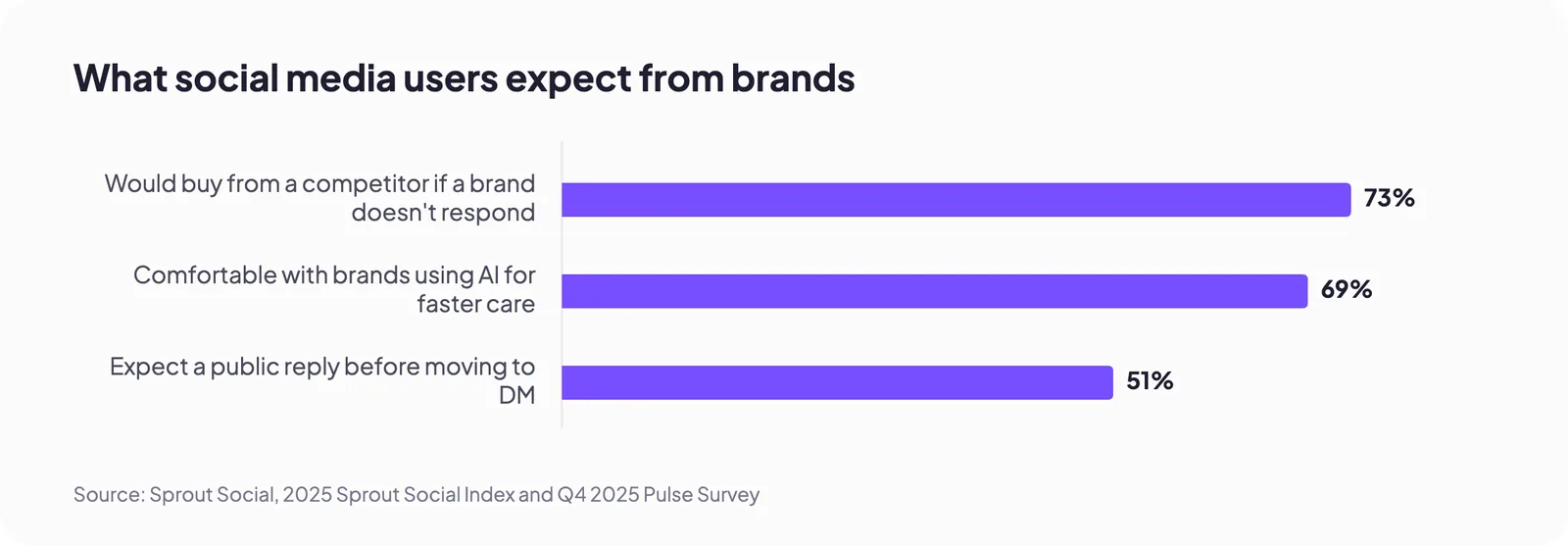
Unanswered comments are visible to everyone who scrolls past them, and customers act on that silence. Nearly three in four social users (73%) in the 2025 Sprout Social Index said they would switch to a competitor when a brand leaves them unanswered on social, and roughly the same share want an answer within a day or less (Sprout Social customer service statistics).
A well-run community also gives you free research. The questions people ask under your posts tell you what your product page fails to explain, which objections block a purchase and which content deserves a follow-up. Clean comment sections protect conversion too: a scam link or a wave of insults under an ad is read by every prospect the ad reaches.
How to build a community management strategy in 5 steps
Set objectives and KPIs. Tie each community goal to a business goal (see the table below), then pick two or three numbers you will report every month.
Map your channels and volume. List every account, including ad accounts, and count the comments and DMs each one receives in a normal week. This tells you how many people and how much automation you need.
Write a voice guide and a moderation policy. One page each: how you talk (formal or casual, emojis or not, how you apologise) and what you hide, delete, answer or escalate.
Define routing and escalation. Decide who owns sales questions, support issues, partnership requests, press and crises, and how a message reaches them.
Review weekly. Read a sample of replies, check response times, update saved answers and adjust the rules.
Business goal | Community KPI to track |
|---|---|
Customer loyalty | Response rate, median first response time, share of positive comments |
Sales | Conversations started from comments, links clicked in DMs, leads handed to sales |
Support cost | Share of questions answered from the FAQ without escalation |
Brand safety | Spam and abusive comments hidden, time to hide, escalations handled |
Product insight | Volume of feature requests and recurring complaints by theme |
12 social media community management best practices
1. Set response-time targets per channel
Write a target for each channel and each type of message, for example DMs the same business day and questions under ads within a few hours. Targets make gaps visible and help you plan evening and weekend coverage.
2. Publish community rules and apply them the same way every time
Pin or link a short set of house rules: no insults, no spam, no personal data, no scams. Consistency is what makes moderation defensible. If you hide one insult and leave another, people will call it censorship.
3. Hide first, delete rarely, never delete criticism
Hiding removes a comment from public view without a confrontation. Facebook keeps showing a hidden comment to its author and to the author’s friends (Facebook Help Center), so the author usually does not notice. Keep deletion for scams, illegal content and personal data. Legitimate criticism deserves an answer, not removal. Our guide on handling bad comments on social media gives reply templates.
4. Answer publicly first, then move to DM
In Sprout Social’s Q4 2025 Pulse Survey, 51% of consumers said a brand should acknowledge them in public first, before any move to private messages. A short public reply shows everyone the brand listens; the DM handles order numbers and personal details.
5. Personalize without over-promising
Use the person’s name, refer to what they actually said, and avoid promises only another team can keep. “I have passed this to our delivery team, they will reply here today” beats “We will fix this right away”.
6. Build one shared FAQ
Collect the 20 to 30 questions you answer most, with an approved answer for each: prices, delivery, returns, opening hours, sizing, availability. Your team, your saved replies and any AI assistant should all draw from the same source so answers never contradict each other.
7. Tag and route every conversation
Use a small set of tags such as sales, support, partnership, press and urgent. Tags feed routing (who answers) and reporting (what people talk about). A lead that sits in a support queue for two days is a lost lead.
8. Prepare for difficult questions and crises
Write holding statements in advance for predictable issues: outages, delays, price changes, product recalls. Define the point at which a community manager stops replying and hands over to a manager or legal. The escalation matrix below is a starting point.
9. Watch the comments under your ads
Comments on paid ads and dark posts often do not appear in your Page feed, so they are easy to miss, and they are where spam, scams and competitor links do the most damage to conversion. Check them daily or automate it; see how to monitor comments on Facebook ads.
10. Reward superfans and let members help each other
Thank the people who answer questions for you, feature their content with permission, and ask open questions that invite members to share experiences. Communities where members talk to each other need less brand input over time.
11. Turn comments into insight
Classify comments by sentiment and theme every month and share the top five themes with product and content teams. Comment sentiment analysis shows how to set this up without a data team.
12. Automate the repetitive, keep humans on judgment
Spam removal, FAQ answers and keyword requests are good candidates for automation. Complaints, crises, legal questions and VIP customers need a person. AI for community management works best as a first draft that a human can approve, at least until you trust it on a given topic.
Escalation matrix: who handles what
Situation | Example | Action | Target time |
|---|---|---|---|
Spam, scam, phishing link | “Win an iPhone, click here” | Hide or delete automatically | Immediately |
Simple question | “Do you ship to Belgium?” | Answer from the FAQ | Same business day |
Purchase intent | “How much for the large size?” | Answer and send the link by DM, tag as sales | Within a few hours |
Complaint | “My order is two weeks late” | Public acknowledgement, then DM with support | Same business day |
Abuse or hate | Insults, slurs, threats | Hide, document, report if needed | Immediately |
Potential crisis | Many similar complaints in an hour | Stop scheduled posts, alert manager, use holding statement | Within the hour |
Common mistakes to avoid
Deleting criticism. It usually comes back louder, with screenshots.
Copy-paste replies. The same sentence under 40 comments reads as a bot and invites mockery.
Office-hours only. Comments arrive at night and at weekends, especially under ads that keep running.
Checking organic posts but not ads. Ad comment sections are the least watched and the most exposed.
No written policy. Without one, every moderator decides differently.
Automating complaints. A cheerful automated reply to an angry customer makes things worse.
Tools: native features vs a unified inbox
Native tools are free and enough for a single account with modest volume: Meta Business Suite groups Facebook and Instagram messages, YouTube Studio holds comments with blocked words for review, and TikTok offers keyword filters. Once you manage several networks, ad comments or a team, a unified inbox saves the time spent switching apps and gives you one set of rules. Our guide to social media moderation tools compares the options.
Related guides
How Blabla supports these practices
Blabla turns the practices above into a daily workflow. Comments from Instagram, Facebook, TikTok and YouTube share one queue with your Instagram and Messenger DMs, sorted into to-do, in progress and done, so your response-time targets (practice 1) show up conversation by conversation. Your written policy (practices 2 and 3) runs as moderation rules that hide spam, scams, hate and competitor links as they arrive, under paid ads too. Tags and assignment handle routing (practice 7), AI replies draft answers from your shared FAQ (practice 6) for a person to approve, or go out automatically once you trust them on a topic, and monthly sentiment reports feed practice 11. 7-day free trial, no credit card required.
Conclusion
Good community management is a system, not a personality trait. Write the rules, set response targets, route messages to the right people, automate the repetitive work and review the numbers every week. Do that consistently and your comment sections become a place people trust, and a source of sales and product ideas.